Talking Meme: Patterns I Enjoy
Apr. 18th, 2020 10:32 am![[personal profile]](https://www.dreamwidth.org/img/silk/identity/user.png) corvi
corviTopic suggested by shadaras
I really really really like light interference patterns. These are caused when light waves that are mostly but not completely identical combine in weird ways. The light waves can cancel each other out, or combine to be stronger, or both, making new colours which aren't actually present on anything the light is coming from. Typically the colours made by interference are gold, turquoise, bright blue, brown, magenta, and purple. Not the same as the pure rainbow made by splitting white light apart. It's like a secret rainbow.
An example is a thin layer of colourless oil on top of colourless water. In this case, the "almost but not identical light" are light reflecting off the top of the oil, and light reflecting off the puddle under the oil. If the oil layer is thin, light from those two separate paths is similar enough to combine in weird ways and make colours:


My phone is embarrassingly full of photos of motor oil spilled on streets. Here's another happy photo of interference colour in the fog inside a bottle of store brand peach soda:

Here's a Buprestis beetle hanging out on my car at work. This genus uses thin plates of protein inside their shells to bounce light around so that it combines to make the secret rainbow:

Crows, like beetles, have thin clear sheets of protein in their feathers to give them illusory colours. Least year, the first time I saw a crow each day, I wrote down what colour it appeared to be. Here's my crow-colour diary:

Here's a ... pipe thing ... at the hardware store. There is a vertical pipe welded to a flat base. When the welding was done, the flat base heated up, and the metal began to react with oxygen in the atmosphere. The result was a thin, transparent coat of oxide on the metal. The closer to the weld, the hotter the metal got, so the faster the reaction with oxygen went, and the thicker the layer of oxide is. There's a small section, about halfway to the corner, where the clear oxide layer is exactly the right thickness - the same thickness as the clear layer of motor oil on top of a puddle - to make interference colours, and there's a ragged swirl of secret colour there.

Rain shield over a push button door opener with similar, though fainter, colour. I'm not sure what heated this up. It doesn't look welded in place. Maybe a cutting torch when the metal was cut from a larger sheet?

In the past, before we had accurate thermometers, metal-workers would use the colours that appeared on steel when heated as a way to judge how hot it was, which is obviously freakin' awesome, and was one of my favourite things when I was fooling around with blacksmithing. Steel is always a tradeoff: harder steel holds an edge better but can be brittle and shatter; softer steel is less sharp and less likely to break. A skilled metalworker (I am not) can choose how hard their steel is by how hot they heat it, and they can tell how hot it is by how thick the oxide layer is, which they can tell by what colour it is. This isn't my picture, but it shows the colours steel turns at various temperatures:
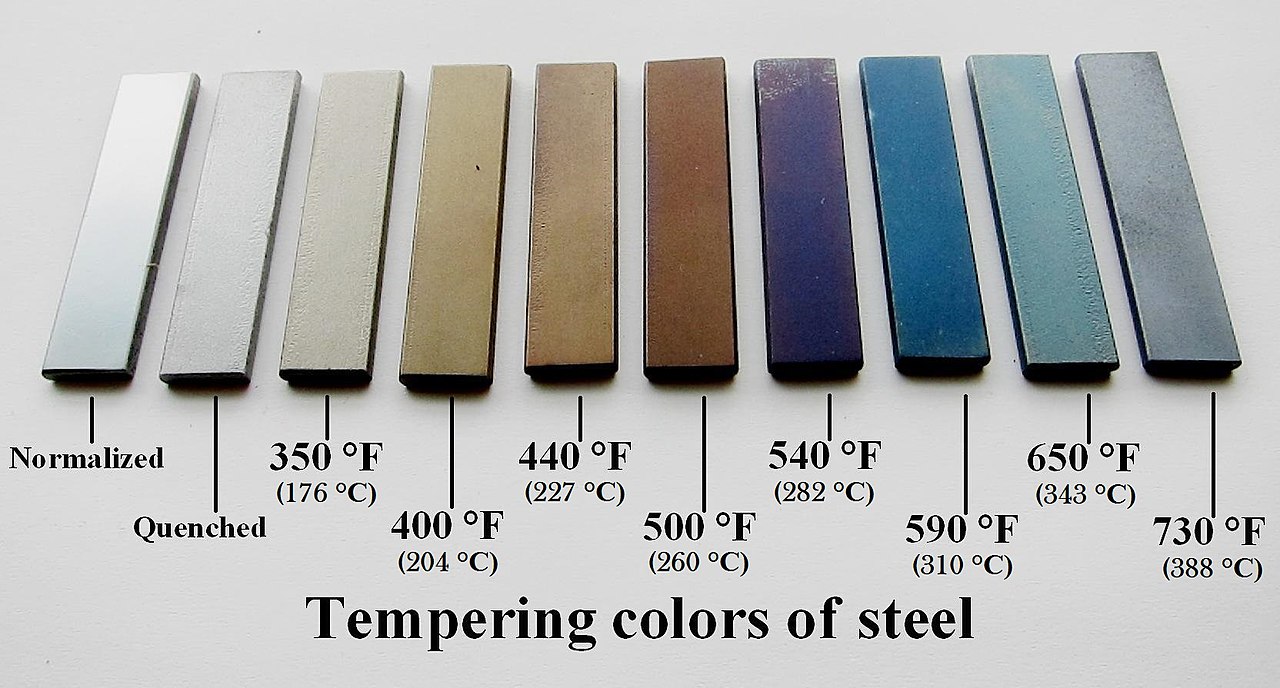
Surgical scalpels used to be heated until they were purple. You want them to be fairly flexible, so the surgeon can cut curves with them easily. Springs to light blue - need all the flexibility. Metal-cutting saws, on the other hand, have to be light yellow: really hard.
Sadly, the thin oxide layer wears off and the colour disappears with basically any handling.
Back to the hundreds of interference photos on my phone! Cloud iridisation, a little hard to see, look for the faint colours in the clouds:


One of the reasons I am so very fond of interference colour is that it seems like an accident. It's a weird side effect of how the physics of reflection and refraction work in our universe. There's not any sort of Law Of Things Appearing To Be Colours They Aren't Because Light Gets Tangled Up With Itself. It's an emergent effect; you put the laws of physics together, and the result is weirder than the sum of the parts. It's easy to imagine someone creating a universe and being like "okay, light is gonna be a wave, it's gonna reflect off things... hey, where's that colour coming from? Whoa, cool."
shadaras I really really really like light interference patterns. These are caused when light waves that are mostly but not completely identical combine in weird ways. The light waves can cancel each other out, or combine to be stronger, or both, making new colours which aren't actually present on anything the light is coming from. Typically the colours made by interference are gold, turquoise, bright blue, brown, magenta, and purple. Not the same as the pure rainbow made by splitting white light apart. It's like a secret rainbow.
An example is a thin layer of colourless oil on top of colourless water. In this case, the "almost but not identical light" are light reflecting off the top of the oil, and light reflecting off the puddle under the oil. If the oil layer is thin, light from those two separate paths is similar enough to combine in weird ways and make colours:
My phone is embarrassingly full of photos of motor oil spilled on streets. Here's another happy photo of interference colour in the fog inside a bottle of store brand peach soda:
Here's a Buprestis beetle hanging out on my car at work. This genus uses thin plates of protein inside their shells to bounce light around so that it combines to make the secret rainbow:
Crows, like beetles, have thin clear sheets of protein in their feathers to give them illusory colours. Least year, the first time I saw a crow each day, I wrote down what colour it appeared to be. Here's my crow-colour diary:
Here's a ... pipe thing ... at the hardware store. There is a vertical pipe welded to a flat base. When the welding was done, the flat base heated up, and the metal began to react with oxygen in the atmosphere. The result was a thin, transparent coat of oxide on the metal. The closer to the weld, the hotter the metal got, so the faster the reaction with oxygen went, and the thicker the layer of oxide is. There's a small section, about halfway to the corner, where the clear oxide layer is exactly the right thickness - the same thickness as the clear layer of motor oil on top of a puddle - to make interference colours, and there's a ragged swirl of secret colour there.
Rain shield over a push button door opener with similar, though fainter, colour. I'm not sure what heated this up. It doesn't look welded in place. Maybe a cutting torch when the metal was cut from a larger sheet?
In the past, before we had accurate thermometers, metal-workers would use the colours that appeared on steel when heated as a way to judge how hot it was, which is obviously freakin' awesome, and was one of my favourite things when I was fooling around with blacksmithing. Steel is always a tradeoff: harder steel holds an edge better but can be brittle and shatter; softer steel is less sharp and less likely to break. A skilled metalworker (I am not) can choose how hard their steel is by how hot they heat it, and they can tell how hot it is by how thick the oxide layer is, which they can tell by what colour it is. This isn't my picture, but it shows the colours steel turns at various temperatures:
Surgical scalpels used to be heated until they were purple. You want them to be fairly flexible, so the surgeon can cut curves with them easily. Springs to light blue - need all the flexibility. Metal-cutting saws, on the other hand, have to be light yellow: really hard.
Sadly, the thin oxide layer wears off and the colour disappears with basically any handling.
Back to the hundreds of interference photos on my phone! Cloud iridisation, a little hard to see, look for the faint colours in the clouds:
One of the reasons I am so very fond of interference colour is that it seems like an accident. It's a weird side effect of how the physics of reflection and refraction work in our universe. There's not any sort of Law Of Things Appearing To Be Colours They Aren't Because Light Gets Tangled Up With Itself. It's an emergent effect; you put the laws of physics together, and the result is weirder than the sum of the parts. It's easy to imagine someone creating a universe and being like "okay, light is gonna be a wave, it's gonna reflect off things... hey, where's that colour coming from? Whoa, cool."


#/media/File:Tempering_standards_used_in_blacksmithing.JPG)
no subject
Date: 2020-04-18 08:16 pm (UTC)no subject
Date: 2020-04-19 02:28 am (UTC)no subject
Date: 2020-04-19 03:12 am (UTC)no subject
Date: 2020-04-19 04:00 pm (UTC)no subject
Date: 2020-04-19 04:23 pm (UTC)no subject
Date: 2020-04-19 07:41 pm (UTC)no subject
Date: 2020-04-18 08:36 pm (UTC)This is utterly delightful, and this kind of color-thing is also one of my favorites -- and nothing what I was expecting when I asked about patterns! Thank you for this delightful array of lovely photos. <3
no subject
Date: 2020-04-19 03:56 pm (UTC)What sort of things did you have in mind for "patterns"? I was definitely thinking visual patterns; I also considered talking about favourite design motifs.
no subject
Date: 2020-04-19 05:10 pm (UTC)I was thinking visual and/or mathematical patterns! What I meant, mostly, was that this kind of iridescent effect wouldn't have occurred to me as a pattern, so it's cool to see it discussed under the category of patterns.
no subject
Date: 2020-04-18 09:19 pm (UTC)The more color you know, the more color you see! :)
The original was a comic strip line about science.
no subject
Date: 2020-04-19 03:59 pm (UTC)no subject
Date: 2020-04-19 04:56 pm (UTC)Vulcan-Klingon Linguistic WarsSapir-Whorf Hypothesis before. :) Words aren't the bars of a cognitive cage, but the bricks of a creative house, because we invent new words for new things.no subject
Date: 2020-04-20 01:09 am (UTC)I do think a crow scarf would be great. I have friends who made temperature scarves for particular years in Chicago based on a similar principle.
no subject
Date: 2020-04-20 04:04 pm (UTC)