corvi: (Default)
My Chinese brushpainting instructor gets irregular leftover chunks of marble from contractors who do marble countertops for fancy kitchens. She grinds them up with a mortar and pestle. She mixes the opaque shimmering marble dust with translucent vegetable pigments to allow light colours to be overlaid on dark colours without the dark colours completely bleeding through. The effect is almost luminous, like clouds of lighter foliage on tree:


Las week in class we experimented with marble dust to create texture, not colour.
to make a mountain out of marble dust )
corvi: (Default)
Let's just ignore the fact that I last posted six months ago.

Today in brush-painting class, we worked on pareidolia, looking at random jumbles of ink and loosing the pattern-hungry human brain to see something meaningful that can be developed. I really like a lot of art made this way; you don't tell the ink what to do, you move with it, like aikido.

orogenics )
corvi: (Default)
Brush painting classes have resumed! The first new class was on the same topic as the last old class: indigo resists. This time we painted the alum in thin lines, so that when we added indigo, there were pale streaky lines in the blue, to represent raindrops.
how to paint a downpour )
corvi: (Default)
Some days you wake up and you need to paint a vulture and plum blossom monster even though it's not a traditional Chinese brush painting subject.

image )
corvi: (Default)
(I actually have not had brush painting class for quite a while, due to COVID concerns, but I am still catching up on summaries from when I did; writing them helps me remember what I learned. I hope.)

One of the other students asked the instructor to teach us how to apply colour. She has done small demonstrations of colour here and there before, and I've done some colouring extrapolating from what she's said, laying down multiple thin layers of different colours, but today she explained how to do it right. I was not doing it right.
drills and dots )
corvi: (Default)
The instructor had us paint crabs and shrimp. Crabs are a traditional autumn motif, but there's not much in the way of traditional symbolism or rules. They're considered freeform and improvisational.
vice admiral pinchy and a handful of nebula )
corvi: (Default)
Painting class restarted yesterday! I have become quite unused to being around people, and that part was rather intimidating.

Surprisingly, I was the only returning student; there were also three new students. We painted bamboo, which is the traditional first step to learning the traditional flower school of brush painting. Since I've been studying the mountain school, I hadn't done bamboo before.

.notes from class on how to bamboo )
corvi: (Default)
Last Sunday's painting class was the last one for a while. The instructor suggested everyone practice plum blossoms, and that even those of us studying Mountain Style take a break from our stone and mist. I hadn't painted flowers before, and really enjoyed it.
flowers )
corvi: (Default)
Today was the last Chinese brush painting class of the year, and the brush painting instructor taught a traditional snow painting technique. It's magic!

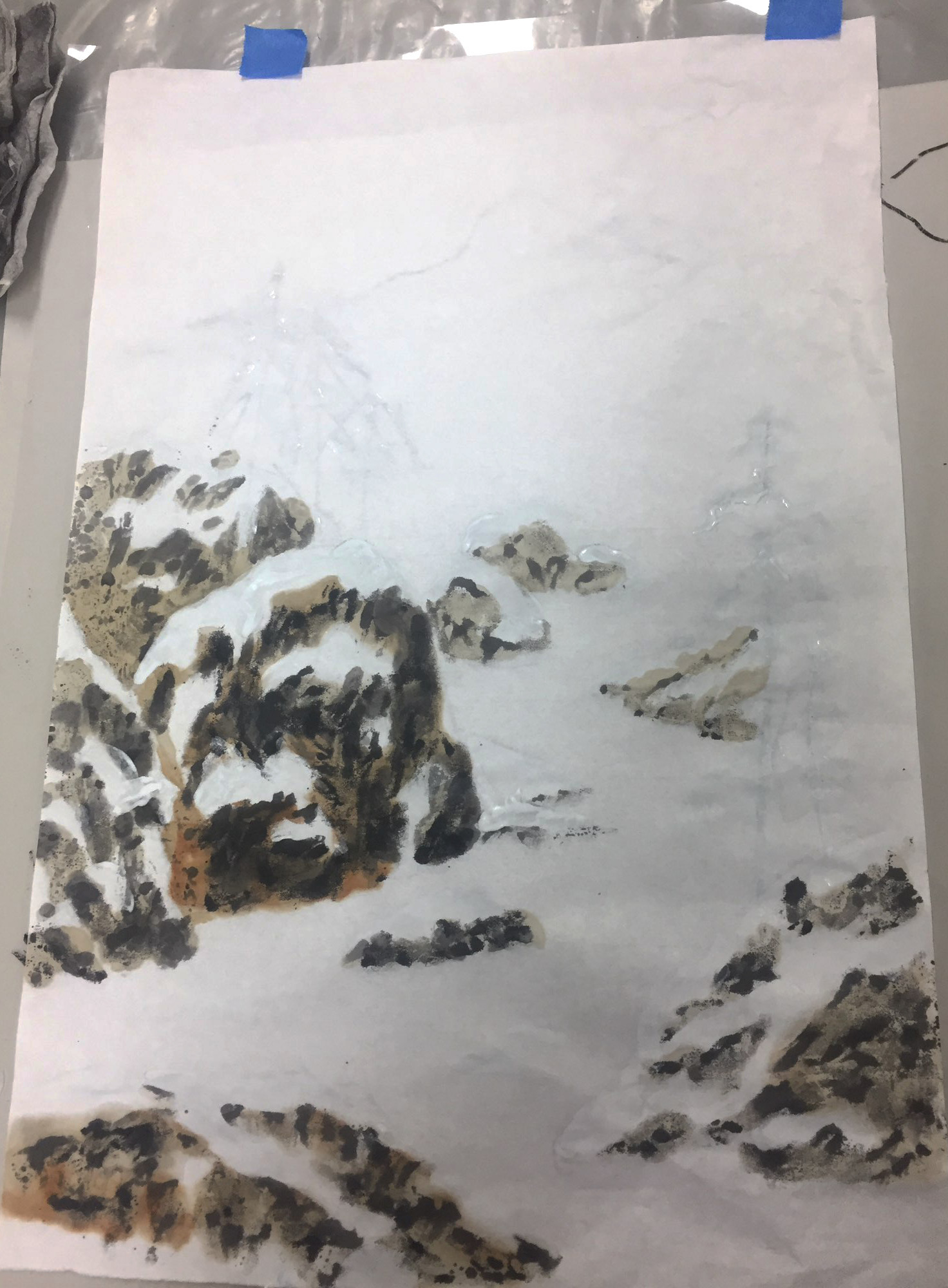
First you paint all the rocks:


Then you take a supersaturated alum/water solution, which is completely transparent, and you transparently paint all the snowy bits: mountains, trees, snow piled atop rocks. It's maddening because you can't see what you're doing. Did I just make a bunch of tree branches hanging in space unconnected to the trunk? (spoiler: yes)

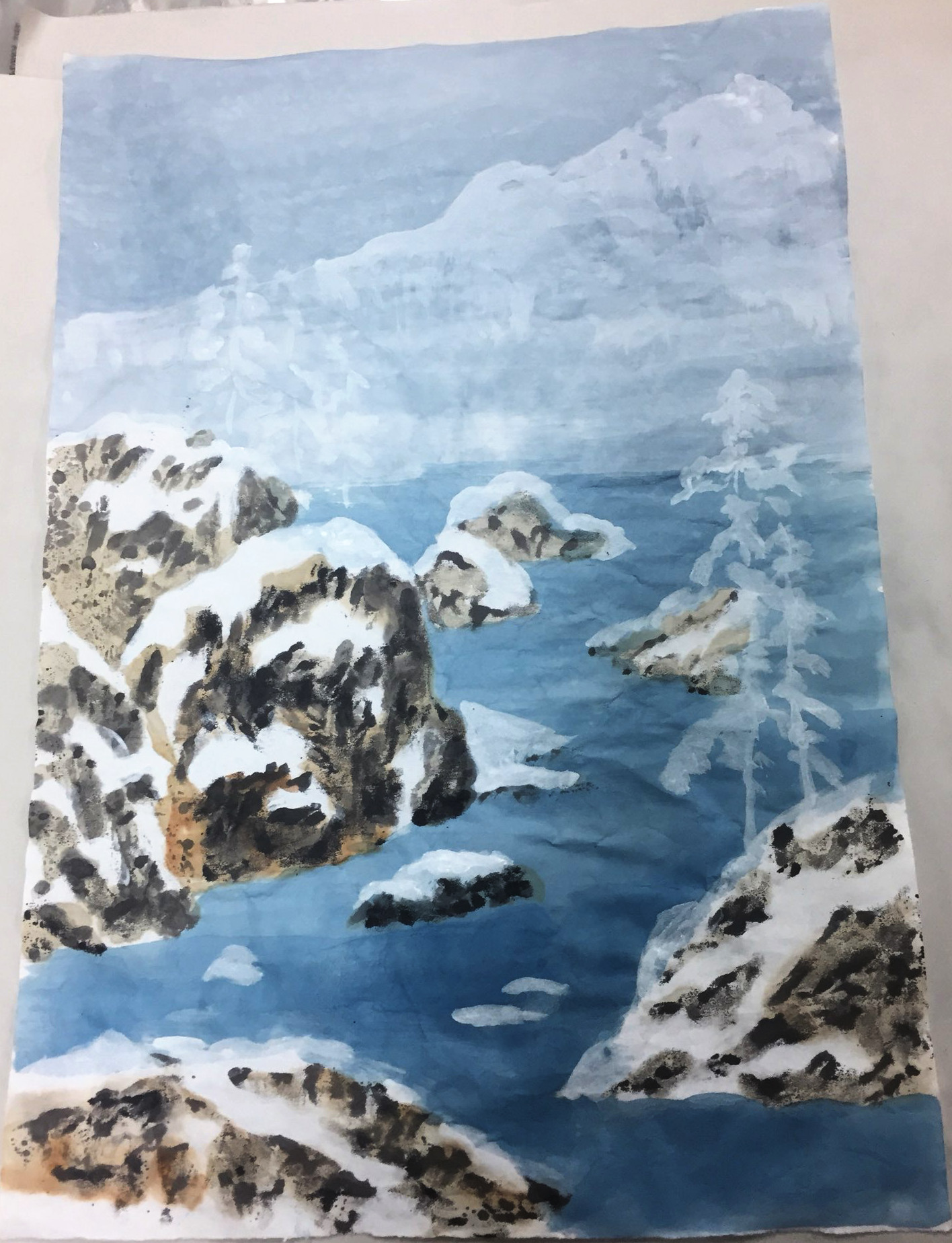
Then you turn the rice paper over, and paint the entire back of it with indigo. Where the alum has soaked into the paper, it partially prevents the indigo from soaking through from the back. But even where the alum wasn't painted, the indigo has a luminous quality and some depth, very different feeling soaking it through from the back than just placing it on top of the paper in front.

And then you turn the paper back over and the magic trick has occurred, right on schedule.


There's a lot that needs to be cleaned up, shaded, or connected still, but ... snow!! :D It's a very good magic trick.
corvi: (Default)
For the last two lessons, the Chinese brush painting teacher had us working on looking at random ink splotches applied via crumpled paper and looking through them to see rocks, which we would then bring up out of the noise via judicious application of ink washes. I found this, er, difficult, and produced a lot of cubist rocks with nonsense geometry (but, alas, not in an interesting deliberate way).

This time, instead of starting with nearly random ink, she taught us techniques that were more like applying random distortions to the ink you meant to put down. It would still do what you wanted ... very approximately.

I loved it. It was like I'd been hiking with a heavy pack for the past two lessons, and now finally I'd gotten to the campsite and had taken it off and was walking unencumbered. Ink only wandering about the page semi-randomly felt almost too easy.
glue and salt, sea and stone )
corvi: (Default)
(Previous lesson: Contingent stones 1)
We did another contingent stones lesson: crumpling paper, painting ink along the resulting ridges and hollows, and then using that to stamp unpredictable lines on the page, which we then attempted to develop into jagged stones, cliffs, and mountains. I remain terrible at it.
accidental rocks )
corvi: (Default)
I did not do any homework for brush-painting class this week, as I was frantically trying to finish a papercut for the Fall Fair instead.

Every painting in the Mountain Style (the style I am studying) features rocks. So it's important to be able to make a lot of different kinds of rocks - jagged rocks, swirly wind-carved rocks, slippery moss rocks - so you're not just putting the Same Three Rocks into every painting. 

The instructor was still in a rock-teaching mood, but took the exact opposite approach this week. Instead of teaching the formal artistic conventions around creating rocks - brush strokes layout - she had us make random ink marks on the paper. Then she had us look at our ink marks and try to see in them the planes and facets of stones, as an exercise in understanding rocks as 3-dimensional objects. Then we were to add ink to highlight and bring forward the rocks that were already there on the page.
rocks )
corvi: (Default)
Hooray, Chinese brush painting classes have resumed! Today the instructor decided everyone should practice rocks, which I've done before, but was happy to return to in more depth.

The instructor demonstrated three different techniques for painting rocks:


This rock is drawn with a stroke called "spread out hemp fiber." I missed the very beginning of the demonstration, so I'm not sure how to do it, but I like the way the way it's a long graceful stroke but still has jagged frayed edges without thinning or fading.


This rock is drawn with the "axe head" stroke. This one I know how to do! I used it for the rocks around waterfalls. It's a long straight stroke done with the side of the brush, and then you sweep the brush sideways at the end to get jagged thorn shapes. It's good for rough rocks with corners and cracks, or, done sideways, for slate and layered beds.


This is the "veins of a lotus leaf" stroke. It's done lightly with the side of the brush. It's for sandstone and other soft rocks carved by wind and water.

Other useful rock techniques:
  • rocks should have three "sides", a left, a right, and a top, like an isometric drawing of a cube
  • lines at the top of a rock should be thinner
  • you can shade the rock either according to where light falls, according to what's closest to the viewer, or both
After she finished demonstrating rockmaking, we sat down to practice rocks. I was mixing ink while the instructor went and dug through one of her piles of art and got out a different piece and put it in front of me. 

It was an abstract scene of waves crashing against rock, with a roiling and menacing energy, like it was about to escape the page and knock you over. I had no idea brushpainting could produce anything so intense. The sea was a broken indigo. The stones were jagged, with gaps and hollows lashed by spray. I have no idea what kind of stroke was used for the rocks, unless she was firing the paintbrushes at the page with a crossbow.

"No, do this one," the instructor said. I stared at it transfixed.

"Uh." I said. "Um. I was going to practice the lotus leaf vein stroke."

"I'm forcing you to do this one!" she said, and laughed cheerfully.

I love the instructor's willingness to just straight up tell me what to do and what to work on to become a better painter, but I had no idea how to begin to make something like this. It didn't seem like something you could actually make on purpose.

"It looks... complicated," I said.

"OK. Do this one instead, it's the same kind of rocks. Next week, the ocean."

So she gave me a different piece to learn from, and I did these rocks jutting up out of an implicit ocean (axe head stroke):

They don't look like the same kind of rocks at all.  I don't think I'm actually any closer to painting the shattered-indigo sea lashing against the stone.

(Narratively, I'm not sure how this turns out. Either this is the part of the movie where the training montage happens, or a bunch of other stuff happens first, and after the credits roll, it cuts to me, after every other problem in my life has been resolved, old and wise and finally at peace, painting that scene.)

Profile

corvi: (Default)
corvi

November 2023

S M T W T F S
   1234
567 89 1011
12131415161718
19202122232425
2627282930  

Syndicate

RSS Atom

Most Popular Tags

Style Credit

Expand Cut Tags

No cut tags
Page generated Jan. 6th, 2026 11:08 pm
Powered by Dreamwidth Studios